





Planning a classic 7-day Tanzanian game drive across iconic parks requires a clear understanding of statutory tariffs, government levies, and park logistics[cite: 1]. Travelers often wonder how park entry costs are calculated, why quotes vary between safari operators, and what exact charges apply at entry gates[cite: 1]. Learning how to understand TANAPA conservation fees for 7 days safari ensures you avoid unexpected expenses, verify quote accuracy, and budget effectively for an unforgettable wildlife trip[cite: 1].
1. What Are TANAPA Conservation Fees & Why Are They Mandatory?
Understanding Statutory Government Levies, the 24-Hour Gate Permit Rule, and Conservation Funding in Tanzania.
1.1 Detailed Definition & Legal Mandate of TANAPA
The Tanzania National Parks Authority (TANAPA) is the statutory government body established under the National Parks Act (Cap 282) responsible for managing, preserving, and operating 22 national parks across Tanzania[cite: 1]. These protected areas include world-renowned sanctuaries such as the Serengeti, Tarangire, Lake Manyara, Arusha, Mount Kilimanjaro, Ruaha, and Nyerere National Park[cite: 1]. When you visit these destinations, the mandatory charges listed as Conservation Fees are not standard tourism entry tickets; they are statutory government levies dedicated directly to protecting the country's delicate ecosystems[cite: 1].
These statutory conservation tariffs serve as the primary financial mechanism supporting critical wildlife conservation initiatives[cite: 1]. Every dollar collected from international travelers via the official Government Electronic Payment Gateway (GePG) directly funds essential operational activities[cite: 1]:
- Anti-Poaching Patrols & Wildlife Protection: Funding 24/7 ranger patrols to protect endangered wildlife species against illegal poaching activities[cite: 1].
- Infrastructure & Road Maintenance: Maintaining all-weather gravel tracks, bridges, and bush airstrips inside park boundaries for safe safari vehicle navigation[cite: 1].
- Ecological Research & Animal Tracking: Monitoring animal migration patterns, fauna health, and long-term climate impact on natural habitats[cite: 1].
- Community Development & Outreach (CSR): Building schools, health clinics, and clean water wells for communities bordering national parks to mitigate human-wildlife conflict[cite: 1].
Looking to Compare 7-Day Safari Package Costs?
Read our comprehensive guide breaking down tour quotes, hidden costs, and operator markups.
1.2 How TANAPA Tariffs Impact Your 7-Day Safari Budget
When evaluating a safari price quote provided by a tour operator, government statutory tariffs (TANAPA and NCAA fees) account for approximately **35% to 50% of the total trip cost**[cite: 1]. Unlike private game reserves elsewhere in Africa that bundle entrance costs into room rates, TANAPA operates strictly under a **24-Hour Gate Permit Rule**[cite: 1].
This rule dictates that every park entry permit remains valid for exactly 24 consecutive hours from the exact timestamp recorded upon entry[cite: 1]. If you stay inside the park or re-enter through the gate even a few minutes past the 24-hour window, the digital system automatically levies a brand-new full-day permit charge[cite: 1].
Practical 24-Hour Cycle Example:
If you enter Serengeti National Park through Naabi Hill Gate at 2:00 PM on Day 1, your permit is valid until 2:00 PM on Day 2[cite: 1]. Exiting the park or passing through the gate at 3:30 PM on Day 2 requires purchasing an additional $82.60 USD permit for the second 24-hour block[cite: 1].
Planning a Fly-In Safari to the Serengeti?
Learn expert tips on saving money on park fees, airstrip transfers, and internal flight logistics.
1.3 Cashless Gate Policies, Verification, and Compliance
To ensure complete financial transparency and streamline operations, all TANAPA and NCAA entry gates operate on a strict **cashless payment policy**[cite: 1]. Physical cash is strictly rejected at all park entry checkpoints[cite: 1]. Payments must be processed beforehand by licensed safari operators or settled digitally on-site using credit cards (Visa or MasterCard) via official Government Electronic Payment Gateway (GePG) control numbers[cite: 1].
This makes choosing a fully licensed and officially registered safari company essential[cite: 1]. Unlicensed or illegitimate operators failing to issue valid pre-paid smart cards or GePG permits will cause severe delays at park gates during mandatory ranger verifications[cite: 1].
For detailed steps on verifying tour operator credentials and licenses before making any booking deposit, read our guide on how to check if a Tanzanian safari company is officially registered and licensed [cite: 1].
Planning a Tarangire & Ngorongoro Itinerary?
Get a complete day-by-day route breakdown for combining Tarangire, Serengeti, and Ngorongoro Crater.
Statutory Rate Structure & 18% VAT Rule
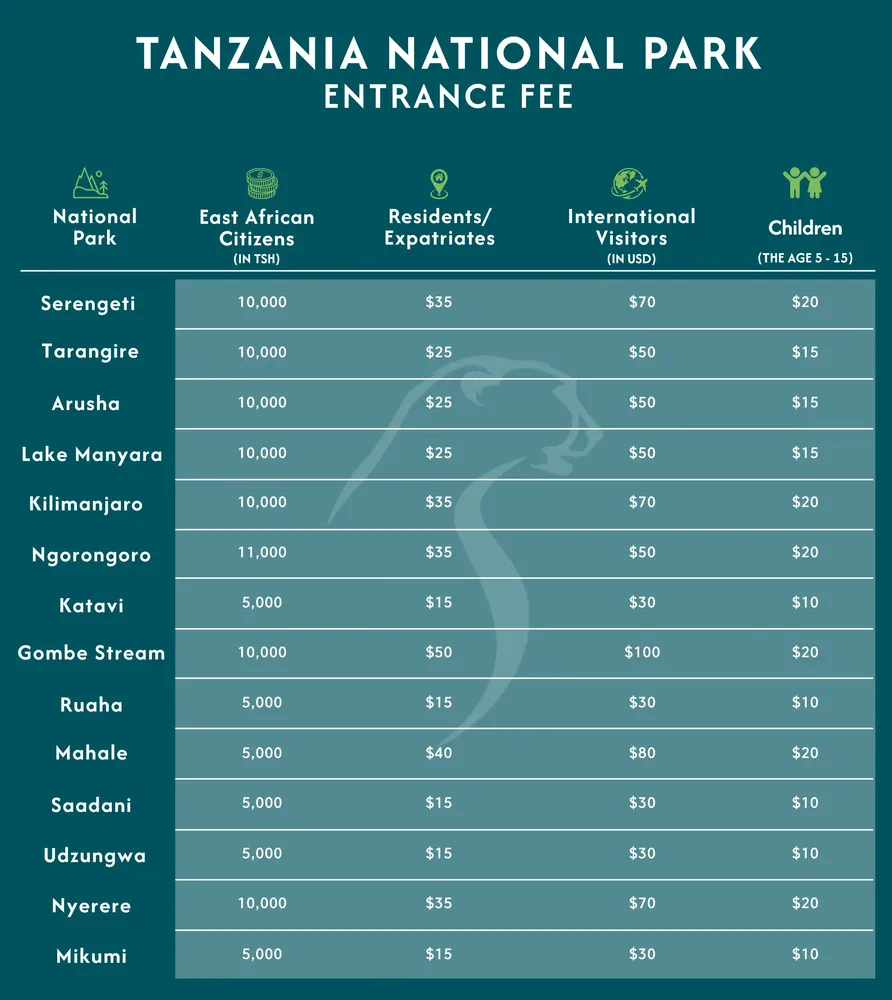
TANAPA categorizes conservation fees based on park popularity, season, and visitor nationality[cite: 1]. Non-resident adult visitors (16 years and older) pay the highest rate tier in USD ($), while children aged 5 to 15 pay discounted child rates[cite: 1]. Children under 5 years enter free of charge across all TANAPA parks[cite: 1].
Crucially, all base tariffs listed on official TANAPA tariff cards exclude Tanzania's 18% Value Added Tax (VAT)[cite: 1]. When calculating total entry costs, an additional 18% must be added to every conservation fee, concession fee, and vehicle permit fee[cite: 1]. Below is the statutory baseline entry fee structure for major parks:
| Park / Zone | Base Rate (Excl. VAT) | Total Fee (Incl. 18% VAT) |
|---|---|---|
| Serengeti (Peak: May-Mch) | $70.00 USD | $82.60 USD |
| Serengeti (Low: Mch-May) | $60.00 USD | $70.80 USD |
| Tarangire / Lake Manyara | $50.00 USD | $59.00 USD |
| Ngorongoro Conservation Area* | $70.00 USD | $82.60 USD |
| Ngorongoro Crater Service (Per Vehicle) | $250.00 USD | $295.00 USD |
*Note: Ngorongoro Conservation Area is managed separately by NCAA (Ngorongoro Conservation Area Authority), but uses similar 24-hour entry structures alongside TANAPA parks[cite: 1].
7-Day Northern Circuit Fee Calculation Breakdown
To accurately calculate how to understand TANAPA conservation fees for 7 days safari, let us analyze a realistic 7-day Northern Circuit itinerary for an adult non-resident traveling during peak season[cite: 1]. A standard route includes Tarangire National Park, Serengeti National Park (3 days), Ngorongoro Crater, and Lake Manyara[cite: 1].
- Day 1: Tarangire National Park Entry — 1 Park Entry Fee = $59.00 USD (incl. VAT)[cite: 1].
- Day 2 to Day 4: Serengeti National Park (3 x 24-hr Permits) — 3 Conservation Fees x $82.60 = $247.80 USD[cite: 1].
- Serengeti Nightly Concession Fees (3 Nights in Tented Camp) — 3 Nights x $70.80 = $212.40 USD[cite: 1].
- Day 5: Ngorongoro Conservation Area Entry — 1 NCA Entry Fee = $82.60 USD[cite: 1].
- Day 6: Ngorongoro Crater Game Drive Service Fee — $295.00 USD vehicle fee split per passenger (e.g., $147.50 USD per person for 2 travelers)[cite: 1].
- Day 7: Lake Manyara National Park Entry — 1 Park Entry Fee = $59.00 USD[cite: 1].
Summing these statutory charges reveals that mandatory conservation and authority fees total approximately $660.80 USD to $780.00 USD per adult traveler for a 7-day trip, excluding vehicle daily road permits and driver-guide fees[cite: 1].
Conservation Fees vs. Nightly Concession Fees
A common source of confusion when reading safari itineraries is the distinction between Conservation Fees and Concession Fees[cite: 1]. Both are official government levies, but they serve different purposes[cite: 1]:
- Conservation Fee: Charged for entering and spending 24 hours within the park borders during game drives[cite: 1].
- Concession Fee: Charged when staying overnight inside a park or conservation area at a permanent lodge, public campsite, or luxury mobile tented camp[cite: 1]. The statutory concession fee inside Serengeti or Ngorongoro is $60.00 USD base rate + 18% VAT = $70.80 USD per person per night[cite: 1].
If your lodge is located outside the park gates (for example, in Karatu town near Ngorongoro or Mto wa Mbu near Lake Manyara), you do NOT pay the nightly concession fee[cite: 1]. However, staying outside means re-entering the park gate each morning, which starts a new entry cycle if 24 hours have lapsed[cite: 1].
Vehicle Entry Permits & Crater Service Charges
A comprehensive breakdown of vehicle tariffs, statutory VAT taxes, crater descent levies, and group cost-sharing dynamics.
1. Safari Vehicle Entry Permit Fees
In addition to individual visitor conservation fees, every safari vehicle entering TANAPA national parks incurs a daily statutory entry permit based on the vehicle's tare weight classification[cite: 1].
Standard 4x4 safari vehicles (such as customized Toyota Land Cruisers) weighing between 2,000 kg and 3,000 kg incur a statutory base fee of $40.00 USD per day[cite: 1]. Adding the mandatory 18% statutory Value Added Tax (VAT) brings the total daily vehicle permit to exactly $47.20 USD per day for TANAPA national parks[cite: 1].
- Standard 4x4 Vehicle (2,000 kg – 3,000 kg): $40.00 USD + 18% VAT = $47.20 USD per day (24-hour cycle)[cite: 1].
- 24-Hour Gate Permit Rule: Vehicle permits strictly follow the same 24-hour operational cycle from the exact time of entry at the gate[cite: 1].
Planning a Tarangire, Serengeti & Ngorongoro Route?
Read our complete day-by-day guide on structuring a 7-day Northern Circuit itinerary efficiently.
2. Ngorongoro Crater Service Fee
Descending into the Ngorongoro Crater floor requires a separate, specialized statutory vehicle surcharge known as the Crater Service Fee[cite: 1]. This levy is charged per vehicle rather than per person and costs $295.00 USD per vehicle per descent[cite: 1].
6-Hour Descent Regulation:
The $295.00 USD crater service permit grants access to the crater floor for a maximum duration of 6 hours per descent[cite: 1]. Exceeding this 6-hour limit requires issuing an additional full $295.00 USD permit at the ascent gates[cite: 1].
Comparing 7-Day Tour Package Quotes?
Discover how vehicle permits, crater fees, and operator fees impact your overall package price.
3. Group Cost-Sharing Advantages
Since daily vehicle entry fees ($47.20/day) and the Crater Service Fee ($295.00/descent) are fixed costs per vehicle, traveling as a family or group significantly reduces individual travel expenses because these charges are divided equally among all passengers[cite: 1].
| Number of Passengers | Crater Fee ($295.00) Cost Per Person | Daily Vehicle Fee ($47.20) Cost Per Person |
|---|---|---|
| 1 Traveler (Solo) | $295.00 USD[cite: 1] | $47.20 USD[cite: 1] |
| 2 Travelers (Couple) | $147.50 USD[cite: 1] | $23.60 USD[cite: 1] |
| 4 Travelers (Family) | $73.75 USD[cite: 1] | $11.80 USD[cite: 1] |
| 6 Travelers (Group) | $49.17 USD[cite: 1] | $7.87 USD[cite: 1] |
Verify Your Tour Operator Before Paying Deposits
Ensure your safari company is officially registered and licensed to process pre-paid park permits.
Frequently Asked Questions
How much are TANAPA conservation fees for a 7 days safari?[cite: 1]
For a standard 7-day Northern Circuit itinerary, adult foreign non-resident conservation fees range between $530 USD and $710 USD per person, including 18% VAT, park entries, concession fees, and the Ngorongoro crater service fee[cite: 1].
Are TANAPA park fees valid for 24 hours?[cite: 1]
Yes, TANAPA park entry permits are valid for exactly 24 hours from the time of entry if you are staying inside the park[cite: 1]. Exceeding 24 hours incurs an additional full day entry charge[cite: 1].
Is 18% VAT included in TANAPA base tariff rates?[cite: 1]
No, TANAPA tariff cards state fees exclusive of Value Added Tax[cite: 1]. A statutory 18% VAT is added on top of all conservation fees, camping fees, vehicle permits, and crater fees[cite: 1].
What is the difference between TANAPA conservation fees and concession fees?[cite: 1]
Conservation fees grant entry into the national park grounds[cite: 1]. Concession fees are an additional nightly charge ($59 to $70.80 per adult) paid whenever you stay overnight at a lodge or tented camp inside park boundaries[cite: 1].
Can individual tourists pay TANAPA fees in cash at park gates?[cite: 1]
No, cash is strictly not accepted at TANAPA gates[cite: 1]. All fees must be pre-paid electronically via licensed tour operators or paid using Mastercard, Visa, or TANAPA smart cards at official park entry gates[cite: 1].
Official Tariffs & Authority References
For direct regulatory documentation, official tariff updates, and government conservation guidelines, consult the following official authorities[cite: 1]:
- Tanzania National Parks Authority (TANAPA) Official Portal — Official park tariffs, rules, and park regulations[cite: 1].
- Ngorongoro Conservation Area Authority (NCAA) — Crater transit permits and conservation zone entry updates[cite: 1].
- Ministry of Natural Resources and Tourism Tanzania — Wildlife conservation legislation and tourism sector management[cite: 1].
Conclusion & Final Traveler Advice
Mastering statutory park fees, VAT requirements, and concession tariffs for a seamless 7-day Tanzania safari experience.
Grasping how to understand TANAPA conservation fees for 7 days safari provides you with complete financial clarity and absolute transparency over your East African travel investment[cite: 1]. When planning an itinerary across iconic parks such as Serengeti, Ngorongoro Crater, Tarangire, and Lake Manyara, statutory government fees constitute between 35% and 50% of your total package cost[cite: 1]. Knowing where every dollar goes allows you to distinguish between genuine park conservation levies and tour operator service markups[cite: 1].
By verifying that your tour operator’s line-item quote explicitly incorporates all 24-hour park permits, the mandatory 18% statutory Value Added Tax (VAT), night concession fees for in-park lodging, and daily 4x4 vehicle permits, you protect yourself against hidden gate surcharges or unexpected payment delays during your trip[cite: 1].
Want to Compare 7-Day Tour Package Quotes?
Discover how to analyze safari price breakdowns, spot hidden fees, and choose licensed tour operators.
Key Takeaways for Reviewing Your Safari Quote
Before issuing any financial deposit or signing a safari contract with an operator, run through this practical statutory fee verification checklist:
- 24-Hour Permit Alignment: Ensure your game drives align strictly with TANAPA's 24-hour cycle rule to avoid double-charging for single-day park entries[cite: 1].
- 18% VAT Verification: Confirm that all published base tariffs (e.g., $70 base entry for Serengeti) have the compulsory 18% statutory tax calculated on top ($82.60 total)[cite: 1].
- Concession Fee Accounting: If sleeping inside Serengeti or Ngorongoro, ensure the $59.00 to $70.80 per person per night concession surcharge is pre-paid in your voucher[cite: 1].
- Ngorongoro Crater Service Permit: Double-check that the $295 USD per vehicle crater floor descent fee is included in your vehicle operational breakdown[cite: 1].
- Cashless Gate Gateways: Verify that your operator holds active GePG payment cards or official control numbers, as cash is strictly rejected at all TANAPA gates[cite: 1].
Interested in Fly-In Serengeti Safaris?
Learn strategic ways to cut costs on park fees, bush airstrip transfers, and internal flights.
Booking with Licensed Professionals
Navigating statutory park tariffs requires partnering with a legitimate, registered operator registered with the Ministry of Natural Resources and Tourism (MNRT)[cite: 1]. Unlicensed third-party middlemen frequently quote low prices by omitting compulsory VAT or overnight concession fees, leaving travelers stranded at gate checkpoints with unexpected bills[cite: 1].
To protect your booking deposit and guarantee a seamless entry process through Naabi Hill, Loduare, or Ndabaka gates, learn how to check if a Tanzanian safari company is officially registered and licensed [cite: 1].
Planning a Northern Circuit Route?
Get our full day-by-day itinerary guide combining Tarangire, Serengeti, and Ngorongoro Crater.
Ready to plan your hassle-free 7-day wildlife adventure through Tanzania?
Explore Comprehensive Safari Price Guide »