





Evaluating a high-end African journey requires looking closely at logistics, timing, and accommodations. When learning how to evaluate a luxury fly and drive 8 days tanzania safari itinerary breakdown, sophisticated travelers must understand that true luxury blends time efficiency with deep, unhurried wilderness exploration. A hybrid "fly and drive" model utilizes internal bush flights to leap over long, fatiguing dusty road segments while preserving private custom 4x4 vehicles for intense, localized game drives inside iconic reserves like the Serengeti and Ngorongoro Crater.
1. Core Evaluation Metrics for Luxury Safaris
Evaluating an elite private safari itinerary requires moving past beautiful brochure descriptions and examining the specific operational and mechanical details of the trip. A premium journey is defined by how efficiently it manages your time, the privacy of its access, and the deep expertise of its staff. True luxury means minimizing the physical exhaustion of traveling across East Africa while maximizing the time you spend quietly observing wildlife in its natural habitat. When analyzing an 8-day itinerary proposal, you must look closely at three main elements: operational balance, absolute vehicle exclusivity, and the legal status of the service provider.
The Golden Ratio of Logistics vs. Pure Field Experience
The single most common mistake in poorly designed African itineraries is what industry experts call "safari burnout." This happens when an operator plans a schedule that forces travelers to spend up to six or seven hours a day driving across rough, unpaved public highways just to get from one national park to the next. For example, driving over rough dirt tracks all the way from Arusha to the Central Serengeti can take an entire grueling day, leaving travelers exhausted and aching.
A true luxury hybrid fly-and-drive itinerary avoids this issue completely by maintaining a strict logistical balance. As a general rule, any single road transfer between distinct geographic regions should never exceed two and a half hours. If the distance requires more time than that, the itinerary must substitute a domestic bush flight. By flying over these long distances, you preserve your energy and save precious daylight hours, turning what would have been a dusty, tiring drive into a spectacular twenty-minute scenic flight over the Great Rift Valley. This smart planning ensures that you arrive at your lodge relaxed, refreshed, and ready for your afternoon game drive.
Absolute Vehicle Exclusivity and Mechanical Integrity
In high-end travel, the quality of your safari vehicle is just as important as the luxury of your resort. A genuine luxury itinerary must guarantee absolute vehicle exclusivity throughout the entire driving portion of your trip. This means your private group will have sole possession of a custom-designed, extended 4x4 Toyota Land Cruiser. You should never accept a shared vehicle setup where you are grouped with strangers, as this can lead to conflicting priorities regarding daily schedules, photography angles, and how long you spend at wildlife sightings.
Furthermore, you need to verify the exact mechanical features of the vehicles being used. A premier operator utilizes a fleet equipped with heavy-duty upgraded suspension systems, such as Old Man Emu components, which smooth out the bumps on rough wilderness tracks. The vehicles must feature three-dimensional pop-up roofs designed for unobstructed, 360-degree photography, onboard power inverters with universal charging sockets to keep your camera gear alive, and built-in refrigerators stocked with chilled premium drinks. Crucially, seating configurations must be limited to a maximum of four to six guests in a vehicle built for eight, guaranteeing every single passenger a spacious window seat and plenty of room for professional camera bags.
The True Cost of Expert Guiding Standards
A safari guide is much more than just a driver; they are the key link between you and the African wild. The success of your trip depends heavily on your guide's ability to read animal tracks, predict predator behavior, and share deep insights into local ecosystems. High-end safari companies invest heavily in their human resources, employing full-time professional guides who hold advanced certifications from prestigious bodies like the Tanzania Association of Professional Tour Guides (TAPTAG). These elite guides are fluent in multiple languages, possess advanced training in wilderness first aid, and understand the precise lighting angles needed by professional wildlife photographers. When evaluating a high-end itinerary, look for explicit details about who your guide will be, ensuring you avoid companies that hire low-cost, freelance drivers at the last minute during peak travel seasons.
Verifying Legal Credentials and Financial Security
Before making a significant financial investment or wire transfer for a luxury trip, you must carefully verify the operator's official legal standing. It is highly recommended to read our comprehensive operational guide on how to check if a Tanzanian safari company is officially registered and licensed. This initial verification ensures that the company you are dealing with is fully bonded and holds a valid TALA (Tourist Agency Licensing Action) license issued by the Ministry of Natural Resources and Tourism.
Working with an officially licensed operator guarantees that your vehicle has comprehensive commercial insurance and that your guide holds authentic park entry credentials. This completely removes the risk of being delayed at park entry gates like Loduare or Naabi Hill due to unpaid fees or invalid corporate paperwork. To assist you in your planning, the following table breaks down the essential legal documents and operational standards you must verify before finalizing your luxury safari booking:
| Operational Parameter | Required Legal Standard | Impact on Your Luxury Experience |
|---|---|---|
| Corporate Licensing | Valid TALA License & Active HAT Membership | Guarantees compliance with national tourism standards and protects your financial deposit. |
| Vehicle Insurance | Comprehensive Commercial Carrier Cover | Ensures full medical, evacuation, and liability protection while traveling inside remote reserves. |
| Aviation Partnerships | IATA-Approved Scheduled Bush Carriers | Guarantees modern aircraft maintenance schedules and strict adherence to professional flight luggage allowances. |
| Guide Certifications | Advanced Field Guide Credentials (TAPTAG/KATO) | Delivers superior wildlife tracking, deep ecological knowledge, and expert photography support. |
By keeping these core metrics in mind, you can look past basic marketing claims and accurately evaluate a travel proposal. This methodical approach ensures that your 8-day Tanzania safari operates with flawless precision, total safety, and the highest standards of luxury from start to finish.
2. The Ideal 8-Day Hybrid Itinerary Breakdown
A well-structured luxury fly and drive 8 days Tanzania safari itinerary maximizes wildlife encounters. By using domestic bush flights for long distances and luxury 4x4 vehicles inside the parks, you minimize travel fatigue. Below is the industry-standard structural framework for a premium 8-day Northern Circuit journey:
| Day | Destination & Logistics | Primary Activity |
|---|---|---|
| Day 1 | Arusha (Drive from JRO Airport) | Luxury Lodge Briefing & Relaxation |
| Day 2 | Tarangire National Park (Drive) | Private Game Drive among Baobabs |
| Day 3 | Ngorongoro Highlands (Drive) | Cultural Walk & Crater Rim Sunset |
| Day 4 | Ngorongoro Crater Floor (Drive) | Big Five Viewing inside the Caldera |
| Day 5 | Serengeti (Fly from Manyara) | Fly-in Game Drive, Premium Camp Check-in |
| Day 6-7 | Central or Northern Serengeti | Full Day Wilderness Tracking |
| Day 8 | Serengeti to Arusha (Fly back) | Departure via Kilimanjaro Airport |
To evaluate these options effectively, smart planners often learn how to compare prices between local and international tour operators in East Africa. Local operators frequently provide superior ground logistics because they possess direct operational control over their vehicle fleets and employ their own guides.
3. Auditing Aviation and Flight Agencies
The aviation segments of a hybrid fly-and-drive safari are the true backbone of an elite itinerary. While the driving segments offer an intimate, ground-level connection to the landscape, the flying components are what keep the trip feeling luxurious by saving you from days of tiring road travel. In a premium itinerary, these flights should never feel like a basic commuter bus ride; they must be managed with absolute precision, safety, and comfort. To fully understand the complex rules governing regional air travel, we highly recommend reading our detailed industry report on how to choose safe and licensed domestic safari flight agencies in Tanzania before finalizing your booking.
The Danger of Multiple-Stop "Hopper" Flights
The most common way low-cost safari operators save money on a fly-and-drive itinerary is by booking cheap, multi-stop scheduled flights. These flights act like public transit in the sky, stopping at up to four or five different bush airstrips to pick up and drop off passengers from other companies before finally reaching your destination. For example, a direct flight from Lake Manyara to Seronera in the Central Serengeti takes about 35 minutes of smooth, scenic flying. However, a multi-stop hopper flight can stretch that same journey into a stressful three-hour ordeal filled with constant takeoffs, bumpy descents, and long waits on hot, dusty dirt runways.
This does more than just cause physical fatigue; it can disrupt your entire safari schedule. A long delay in the air can cost you your prime afternoon game drive—the crucial time when the intense African sun goes down and large predators like leopards and lions wake up to hunt. When evaluating your 8-day itinerary breakdown, look for explicit guarantees that your flight segments are booked as direct or single-stop flights. If your budget allows, look into private charter options where the entire aircraft is reserved for your party, allowing you to set a customized schedule that perfectly matches your lodge check-in times.
Evaluating Fleet Quality and Safety Standards
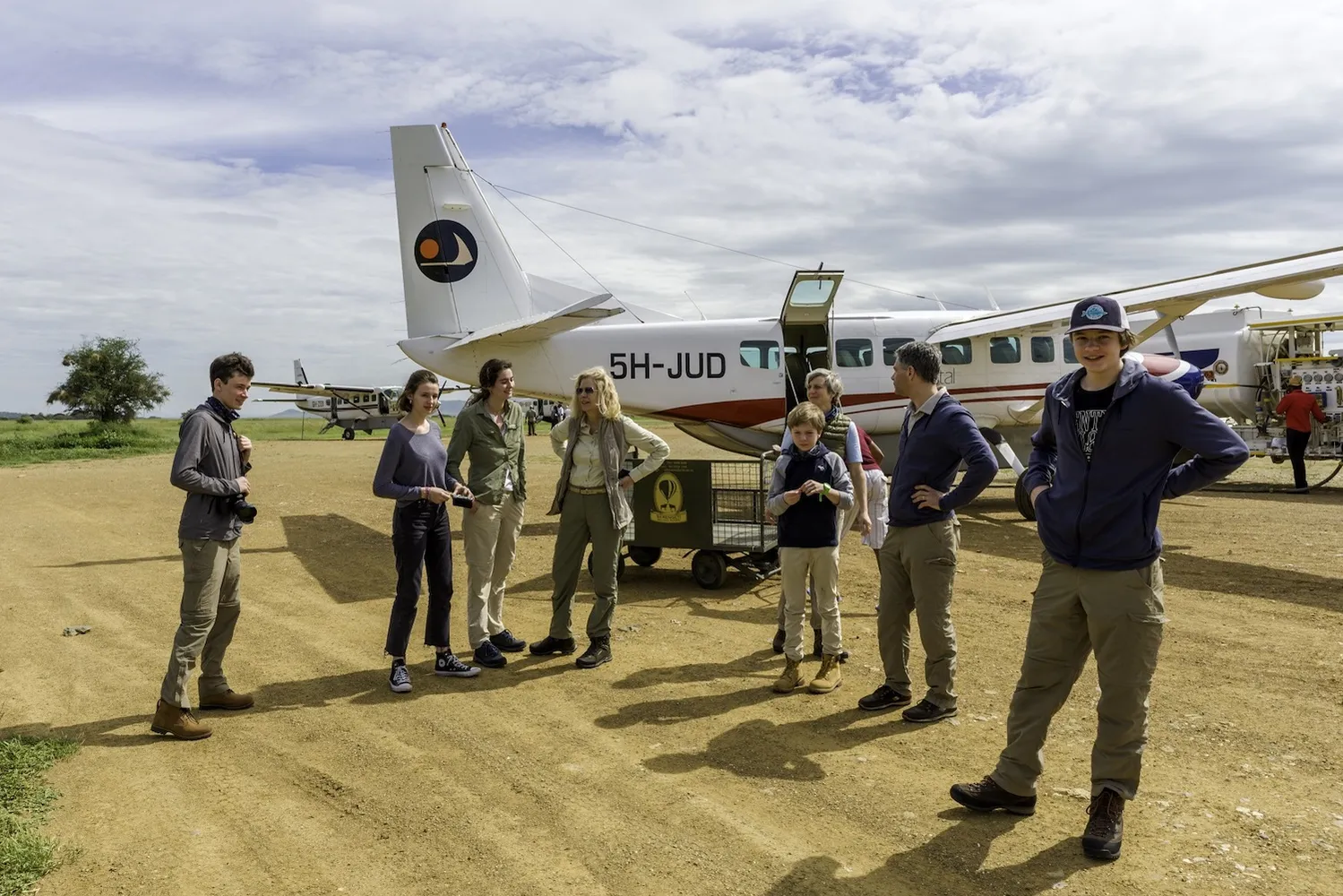
Luxury aviation is defined by the quality of the aircraft and the strictness of the maintenance schedules. High-end safari companies partner with premier regional carriers like Coastal Aviation, Auric Air, or Grumeti Air. These top-tier agencies operate modern fleets made up primarily of unpressurized turbine aircraft, such as the legendary Cessna 208B Grand Caravan or the twin-engine ATR 42. The Cessna Grand Caravan is widely considered the gold standard for bush aviation. Its high-wing design gives every passenger a clear, unobstructed view of the stunning landscapes below, making the flight feel like an extension of your sightseeing experience rather than just a transfer.
When reviewing your options, ensure your operator avoids low-cost providers that use older, piston-engine aircraft. Elite carriers back up their premium service with international safety certifications, including regular independent safety audits from organizations like the Flight Safety Foundation or BARC (Boutique Aviation Review Committee). These strict standards guarantee that your pilots are highly experienced professionals who undergo regular simulator training to handle the unique challenges of landing on remote, unpaved wilderness strips surrounded by wildlife.
Managing Strict Bush Flight Baggage Restrictions
A major surprise for many luxury travelers is the strict baggage limit required by domestic bush aircraft. Because these small planes must operate safely on short, unpaved runways in high temperatures and high altitudes, weight management is critical for safety. Most scheduled bush flights enforce a strict limit of 15 kilograms (33 pounds) per passenger, which must include all hand luggage and camera gear. Furthermore, this luggage must be packed in soft-sided, duffel-style bags without rigid frames or wheels so that ground crews can fit them into the plane's tight pod compartments.
A properly managed luxury itinerary should handle these restrictions smoothly without forcing you to leave essential items behind. Top-tier operators solve this issue by offering custom luggage services. They can arrange for your heavy, hard-sided international suitcases to be securely transported by road from Arusha directly to your final departure airport, or stored safely at their main office while you travel light in the bush. Additionally, premium lodges throughout the Serengeti provide complimentary, same-day laundry services, allowing you to pack light and comfortably stay within the aircraft's weight limits without sacrificing style or convenience.
| Aircraft Type | Optimal Route Segment | Baggage Allowance Type | Key Advantage for Travelers |
|---|---|---|---|
| Cessna Grand Caravan | Manyara Airstrip to Seronera (Serengeti) | 15kg Soft-Sided Luggage Only | High-wing design gives every passenger an excellent view for aerial photography. |
| Twin Otter / ATR 42 | Arusha Airport to Seronera Airstrip | 20kg Premium Scheduled Limit | Twin-engine setup provides extra power and smoother flights over the Rift Valley. |
| Private Helicopter Charter | Custom Lodge-to-Lodge Transfers | Flexible / Customized Weights | Provides point-to-point transfers directly to private lodge helipads, avoiding airports entirely. |
By carefully checking these aviation details, you can ensure your trip avoids the delays, fatigue, and frustration that come with low-cost transport. A premium fly-and-drive itinerary treats air travel as a highlight of the journey, giving you breathtaking aerial views of the Great Rift Valley, ancient volcanic craters, and massive herds of wildlife moving across the plains below.
4. Evaluating Camp and Lodge Specifications
The standard of accommodations selected for your stay serves as the ultimate benchmark for the entire luxury safari experience. True luxury in the African bush is not defined by large, concrete resort hotels that disconnect you from nature. Instead, it is found in intimate, low-impact, ultra-premium boutique lodges and canvas camps that blend into the surrounding ecosystem. When reviewing your Serengeti arrangements, it is crucial to learn how to select reliable mobile luxury tented camp safaris in the Serengeti. These specialized, high-end mobile camps move their entire operations multiple times a year to follow the seasonal paths of the Great Wildebeest Migration, ensuring you sleep right next to the massive herds without sacrificing premium amenities.
The Architecture of Exclusive Wilderness Lodging
When analyzing a luxury 8-day itinerary breakdown, pay close attention to the size and style of the properties. High-end eco-luxury properties limit their total capacity to between six and twelve villas or tented suites. This small size guarantees total privacy, quiet surroundings, and highly attentive service that larger commercial operations cannot match. Premium tented suites are built on elevated wooden platforms and feature large canvas walls with panoramic mesh windows. This design allows the cool evening breeze to circulate while keeping out insects. Inside, you will find polished hardwood floors, hand-woven carpets, vintage brass fixtures, and large king-sized beds draped in high-thread-count Egyptian cotton linens.
The bathrooms in these modern luxury camps rival those of top international city hotels. They feature double porcelain vanities, flushing ceramic toilets, and indoor or outdoor rainfall showers supplied with hot water on demand. Many ultra-luxury safari suites now include private wood-heated or solar-heated plunge pools on their expansive private viewing decks. This gives you a private space to relax and watch elephants, zebras, and giraffes gather at nearby waterholes without ever leaving your room.
Key Infrastructure Requirements for High-End Camps
To ensure a comfortable stay in the wilderness, check the specific operational and utility features of your accommodations. A truly luxury bush camp must meet high operational standards to keep your stay smooth, comfortable, and environmentally friendly:
- Staff-to-Guest Ratio: Premium properties offer an impressive staff-to-guest ratio of at least 2:1 or 3:1. This allows the property to assign a private butler to your suite who manages your daily schedules, prepares your morning coffee, coordinates laundry services, and arranges private dining experiences.
- Power & Sustainable Energy: Elite camps use high-capacity, silent solar power systems paired with large lithium battery storage banks to provide reliable 24/7 electricity. This setup allows you to run CPAP medical machines, charge complex camera setups, and use hair dryers without the constant loud noise of old-fashioned diesel generators.
- Location Advantage: Premium accommodations are positioned deep inside the national park boundaries or within exclusive private concessions bordering the parks. This location allows you to start your game drives right at sunrise, skipping the long queues and delays at the main park entry gates.
- Culinary Standards: Luxury bush dining features gourmet menus designed by executive chefs, utilizing fresh ingredients flown into local bush airstrips weekly. Meals are paired with fine international wines, and dining locations alternate between elegant candlelit mess tents and private multi-course dinners set up under the stars.
Evaluating Concession Choices vs. National Park Ground Rules
An important detail to check in your itinerary breakdown is whether a property sits inside a public national park or within a private wildlife concession. Public national parks like the Serengeti and Tarangire offer unmatched wildlife viewings, but they enforce strict rules to protect the environment. These rules include a ban on driving off-road, mandatory return times to camp by dusk, and no guided walking safaris in most areas.
To enjoy a more flexible experience, the finest itineraries combine public park visits with stays at high-end lodges located in private concessions or wildlife management areas (WMAs) right next to the parks. Properties in these private zones are not bound by public park restrictions. This allows your expert guide to drive off-road to follow elusive predators like leopards and cheetahs, lead thrilling night game drives using special spotlights to see nocturnal animals, and guide walking safaris that give you an up-close look at the smaller details of the African bush.
| Property Type | Optimal Location | Key Advantage | Best Suited For |
|---|---|---|---|
| Mobile Tented Camp | Serengeti Migration Corridors | Stays close to the massive herds all year long. | Wildlife photographers and migration tracking. |
| Permanent Luxury Lodge | Ngorongoro Crater Rim | Stunning views and permanent stone structures. | Honeymooners and premium comfort seekers. |
| Private Concession Camp | Tarangire / Serengeti Borders | Allows night drives and guided walking safaris. | Active travelers seeking exclusive experiences. |
By carefully checking these accommodation details, you ensure your 8-day fly-and-drive safari offers a comfortable, stylish, and highly personalized environment. The right property keeps you closely connected to the sights and sounds of the wild while providing the service, comfort, and dining of a world-class resort.
5. Frequently Asked Questions
What is a fly and drive safari layout?
It is a hybrid luxury travel model where visitors fly over long, rough terrain between distant parks to save time, then use a private 4x4 safari vehicle for intimate game viewing within the reserves.
Why is park placement critical for an 8-day itinerary?
Properties located inside park gates eliminate long daily commutes. This lets you access prime wildlife viewing areas during the cooler, highly active morning hours.
Conclusion: Securing a Flawless Luxury Itinerary
Mastering how to evaluate a luxury fly and drive 8 days tanzania safari itinerary breakdown requires examining every hidden detail of your travel proposal. A truly premium African safari is never built on luck; it is carefully designed by balancing time, logistics, and comfort. By double-checking domestic aviation safety standards, insisting on exclusive custom vehicles, choosing private or mobile tented accommodations, and selecting officially registered local operators, you transform a standard vacation into a flawless, stress-free journey through Tanzania's spectacular Northern Circuit.
The Final Checklist for Smart Travelers
Before you sign a contract or send a wire transfer for your safari deposit, take a moment to look past the beautiful pictures in the brochure. Run your proposal through a final, strict evaluation using these essential requirements:
- No Shared Road Transfers: Confirm that your custom 4x4 Land Cruiser is completely private and reserved only for your group from Day 1 to Day 8.
- Direct or Single-Stop Flights: Double-check that your internal flights (like the hop from Lake Manyara or Arusha to the Serengeti) are direct or have a maximum of one stop, protecting you from wasting your afternoon on a multi-stop commuter plane.
- In-Park Accommodation Location: Make sure your luxury camps are located deep inside the official boundaries of national parks or within exclusive private concessions, rather than outside the main gates.
- Clear, All-Inclusive Pricing: Verify that your final quote includes all expensive park conservation fees, crater service charges, domestic aviation taxes, and premium drinks, leaving no room for unexpected out-of-pocket costs at checkout.
The Value of Local Operational Control
The final pillar of a luxury safari is the operational strength of your chosen tour operator. While large international travel agencies plug your details into third-party booking systems, licensed local operators own their vehicle fleets, employ their guides full-time, and maintain direct lines of communication with lodge managers. This hands-on control is what allows them to handle last-minute schedule adjustments seamlessly—whether that means altering a flight time due to changing weather or preparing a surprise private dinner out in the bush.
Investing the time to carefully analyze your 8-day itinerary ensures that your journey across East Africa will be safe, smooth, and deeply immersive. By paying close attention to aviation logistics, vehicle quality, and lodge design, you protect your financial investment and guarantee an unforgettable journey into the heart of the wild.