





Heavy fog is one of the most stressful weather hazards any driver can encounter on the highway. Unlike rain or snow, thick mist completely distorts your depth perception and strips away your reaction time within seconds. Learning how to drive safely in heavy fog conditions is a fundamental defensive driving skill that saves lives. Whether you get caught in early morning ground haze or a sudden mountain soup, knowing how to adjust your vehicle controls determines whether you arrive home safely or become part of a multi-car highway pileup.
The Core Challenge of Fog Visibility
Fog is essentially a cloud that forms at ground level, consisting of millions of microscopic water droplets suspended in the air. These droplets act like tiny mirrors, scattering light rays in every direction. Statistical analysis from global transport safety boards shows that low visibility conditions contribute to over 25,000 traffic accidents annually. When visibility drops below 0.25 miles, standard driving instincts can fail you. Drivers naturally tend to speed up unconsciously because the lack of visual milestones makes them feel like they are moving much slower than they actually are.
Lighting Protocols: Low Beams vs High Beams
The most common mistake motorists make is turning on their bright high-beam headlights. High beams point directly forward into the mist, throwing light straight into the water droplets. This creates a blinding white wall of back-glare that completely erases whatever little vision you had left.
To master how to drive safely in heavy fog conditions, always switch your light system dial to low beams or dedicated fog lights. Low beams cast light downward toward the pavement, sliding underneath the dense moisture layer where visibility is slightly better. If your vehicle features yellow or amber fog lights, use them; these longer wavelengths cut through airborne haze far better than crisp blue or white xenon bulbs.
| Light Choice | Safety Effect |
|---|---|
| Low Beams | Illuminates the road bed under the mist layer. |
| High Beams | Creates a blinding wall of white light reflection. |
| Fog Lights | Cuts wide angles across asphalt to reveal edges. |
Space Margins and Braking Techniques
In optimal clear weather, a 3-second following distance provides enough safety buffer. However, inside heavy fog, you must increase this space buffer to at least 6 to 8 seconds. Never tailgate or try to match the speed of the vehicle in front of you just to use their taillights as a guide. If they slam on their brakes for an obstacle or drift off a sharp curve, you will follow them straight into a collision.
Keep your foot poised lightly near the brake pedal to reduce reaction lag, and tap your brakes gently well before you actually need to slow down. Tapping flashes your red rear brake markers, giving any vehicle traveling behind you an early warning that you are decreasing speed. According to road safety recommendations from the National Highway Traffic Safety Administration (NHTSA), early deceleration is the single best mechanism to prevent chain-reaction highway collisions during low-visibility events.
Tracking Road Markers Safely
When you cannot see more than a couple of car lengths ahead, staring straight out the center of your windshield can cause spatial disorientation. Your eyes will strain to find a focal point, leading to rapid fatigue.
Instead, shift your gaze toward the right side of your driving lane. Use the solid white painted line—known as the "fog line"—as your primary visual reference point. Tracking this marker keeps your car centered in the lane and prevents you from accidentally drifting left into oncoming traffic lanes. Avoid tracking the center dashed lines, as staring at them can cause you to steer too close to oncoming traffic headlight glare.
When and How to Pull Over Safely
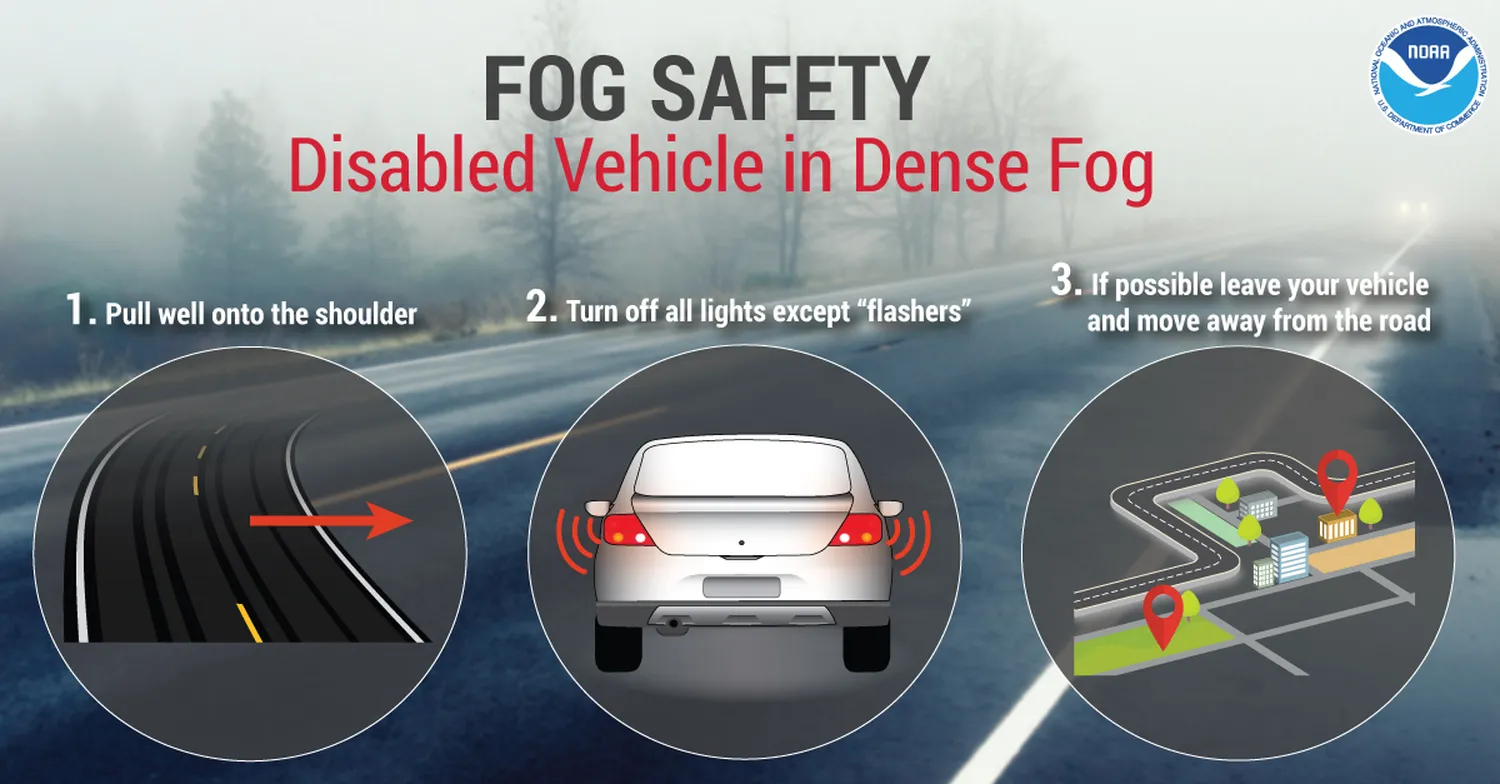
If the mist thickens to a point where you cannot distinguish road lines or see past your hood, it is time to get off the blacktop entirely. Do not simply stop in the middle of a travel lane or park on a narrow shoulder; other drivers coming from behind will see your red lights and ram into you, assuming you are moving forward.
- Signal early and look for an official exit ramp, gas station, or rest area parking spot.
- If forced to park on the roadside shoulder, pull your vehicle as far right onto the grass or dirt as humanly possible.
- Turn off your headlights and tail lights completely once parked. If your main lights stay on, passing cars may mistakenly steer toward you and crash into your rear bumper.
- Engage your emergency parking brake, switch on your four-way hazard flashers, and stay buckled inside your vehicle cabin.
Preparing Your Vehicle for Severe Hazards
Fog safety relies heavily on maintaining crisp, clean glass. High humidity levels inside the cloud cause immediate moisture condensation on both the exterior and interior faces of your windows. Activate your front defroster system and run your air conditioning unit to strip moisture out of the air. Keep your windshield wipers running on an intermittent cycle to sweep away lingering mist particles.
Just like preparing your vehicle for other critical climate challenges, proactive equipment upkeep makes all the difference. For example, knowing how to build a winter emergency kit for your car ensures you have emergency flares and flashlights if you get stranded in frozen fog. Sudden visibility drops can happen during various natural crises; learning how to survive a tornado if you are in a car or mastering how to handle a vehicle when you how to stay safe during a severe thunderstorm requires similar calm, defensive steering adjustments. Keeping your car’s electrical and lighting systems in top tier shape helps mitigate risks across all unexpected road disruptions.
Frequently Asked Questions
Should I use high beams in thick fog?
No, high beams create massive back-glare by bouncing light straight off water droplets into your eyes. Stick exclusively to low beams or designated fog lights.
What line should I follow when visibility drops?
Use the solid white line on the right edge of the road (fog line) as your visual guide. Avoid looking at oncoming center lines to prevent head-on drift.
Is it safe to put my hazard lights on while moving?
In many areas, moving with hazard lights on is illegal and confuses drivers behind you into thinking you are at a complete dead stop. Use them only when pulled over fully off the road.
Conclusion: Drive Smart and Stay Patient
Mastering how to drive safely in heavy fog conditions comes down to patience, reduced speed, and proper equipment settings. Never rush your journey through zero-visibility zones. By dimming your headlights to low beams, expanding your following gap to double its normal distance, and tracking the right shoulder marker, you can navigate through the heaviest ground mist with complete control. When visibility drops too low to manage, prioritize your personal safety by pulling entirely off the roadway until conditions clear.