





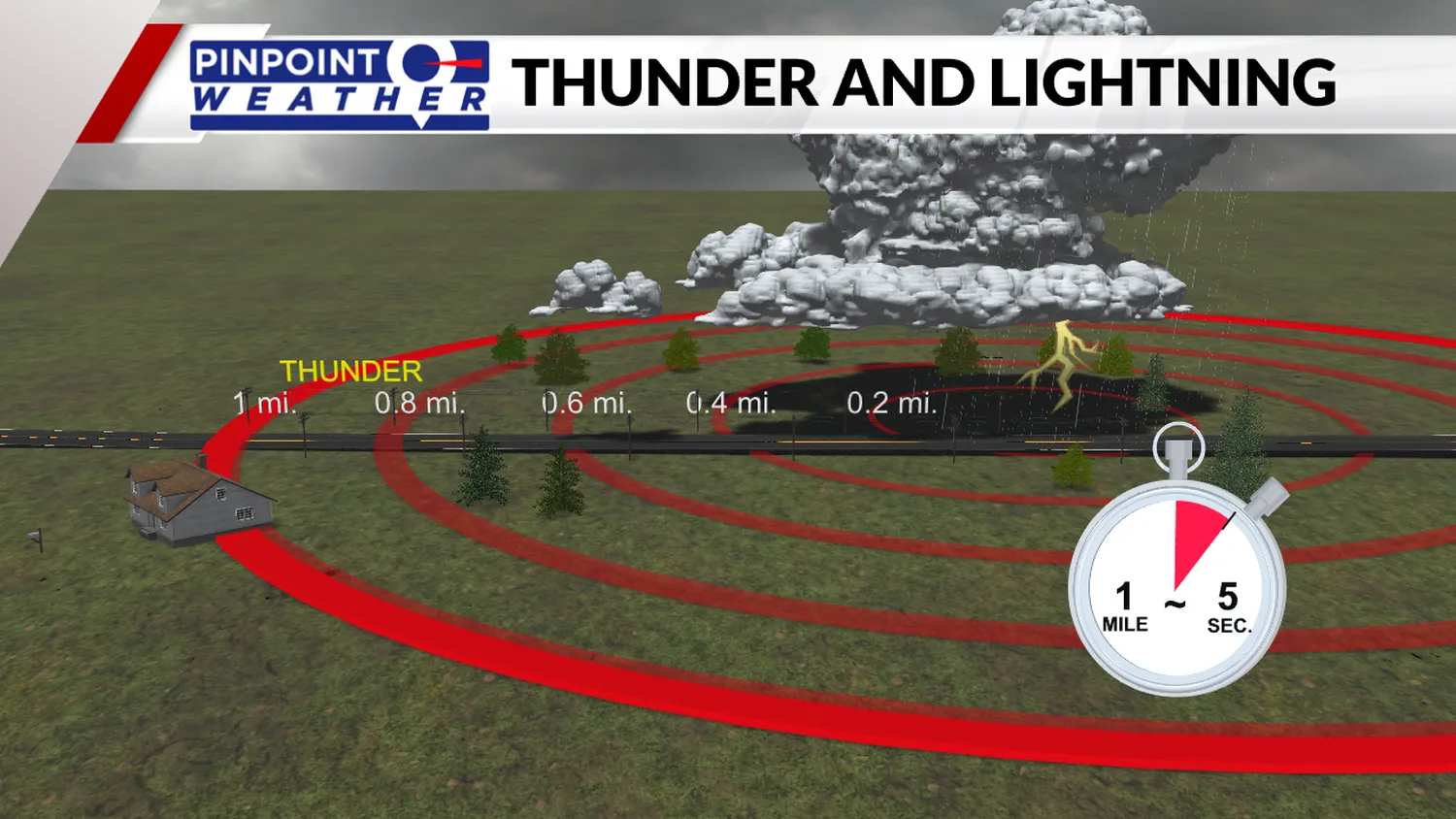
Have you ever watched a thunderstorm roll in and wondered exactly how close you are to danger? Learning how to calculate the distance of lightning by counting seconds is a classic, reliable outdoor skill that relies on basic physics. Known formally as the "flash-to-bang" method, this technique lets you monitor a storm's movement using only your eyes, your ears, and a bit of simple division. By understanding the time gap between seeing a lightning bolt and hearing its thunder, you can make critical decisions to keep yourself and your family safe.
The Science: Why is There a Delay?
Lightning and thunder happen at the exact same moment. The delay you experience occurs because light and sound travel at vastly different speeds. Light travels at an incredible velocity of roughly 186,000 miles per second (299,792 kilometers per second). This means the flash reaches your eyes almost instantaneously, no matter how far away the storm is.
Sound, on the other hand, is much slower. In normal atmospheric conditions, sound travels through the air at approximately 1,125 feet per second, which translates to roughly 343 meters per second. Because sound requires time to bridge the gap between the storm cloud and your position, you can easily use this delay as a natural stopwatch to track incoming severe weather systems.
Step-by-Step Flash-to-Bang Method
If you want to know how to calculate the distance of lightning by counting seconds accurately, follow these simple steps during the next storm:
- Watch the Sky: Keep an eye on the horizon or storm clouds. Wait until you see a bright, distinct flash of lightning.
- Start Counting Immediately: The second you see the flash, begin counting steadily. You can use a digital timer or count manually by saying "one-thousand-one, one-thousand-two, one-thousand-three" to mimic seconds.
- Stop on the Thunder: Listen closely and stop counting the exact moment you hear the first rumble or sharp clap of thunder.
- Do the Math: Use your final number to find your distance:
- To get Miles: Divide the total number of seconds by 5.
- To get Kilometers: Divide the total number of seconds by 3.
Lightning Distance Conversion Table
To help you visual the math without picking up a calculator mid-storm, reference this quick breakdown of seconds converted to distance values:
| Seconds Counted | Distance (Miles) | Distance (Km) |
|---|---|---|
| 3 Seconds | 0.6 Miles | 1.0 Km |
| 5 Seconds | 1.0 Mile | 1.6 Km |
| 10 Seconds | 2.0 Miles | 3.3 Km |
| 15 Seconds | 3.0 Miles | 5.0 Km |
| 30 Seconds | 6.0 Miles | 10.0 Km |
The 30-30 Rule and Storm Safety
While tracking a storm can be fascinating, security should always remain your top priority. The National Weather Service recommends using the 30-30 Rule when dealing with lightning threats:
The 30-30 Safety Rule: If you count 30 seconds or less between the flash and the thunder, the storm is within 6 miles of you. This means you are close enough to be struck and must find substantial indoor shelter immediately. Do not resume outdoor activities until a full 30 minutes have passed since the very last sound of thunder.
If you find yourself stuck outside when a storm is close, avoid tall, isolated trees, open fields, and large bodies of water. Remember that lightning can strike up to 10 to 12 miles away from the main rain core of a thunderstorm, far beyond where most people expect danger to lurk.
Tracking Other Weather Phenomena
Mastering basic observational meteorology allows you to better anticipate daily environment shifts. For instance, pairing your lightning calculations with a guide on how to read a barometer to predict weather changes will give you an advanced warning when sudden low-pressure drop-offs indicate severe storm creation. Alternatively, checking out how to identify different types of storm clouds helps you spot volatile cumulonimbus shapes before the first lightning strike even occurs.
If you enjoy keeping a pulse on local storm patterns right from your backyard, setting up basic instrumentation is an excellent next step. You can easily find out how to make a DIY rain gauge for school projects or learn how to measure wind speed without an anemometer using everyday household items. These skills convert standard storm tracking into a rewarding, practical hobby while ensuring you remain weather-ready year-round.